Accountable Talk

I have just finished reading through a paper entitled Accountable Talk Sourcebook: for classroom conversation that works (Michaels, O’Connor & Williams Hall, 2013).  Again, I was introduced to accountable talk in the Metropolitan sessions led by Lyn Sharratt in February this year.
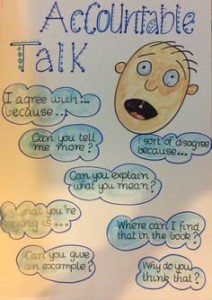
accountable talk 2

Anchor chart from https://tackk.com/fzmr3b

Talking with others about ideas and work is fundamental to learning. We need to be able to organise our thoughts coherently, hear how our thinking sounds out loud, listen to how other respond and hear others expand or add to our thinking.

Michaels, O’Connor and Williams Hall write that to promote learning, classroom talk must be accountable – to the learning community, to accurate and appropriate knowledge, and to rigorous thinking.
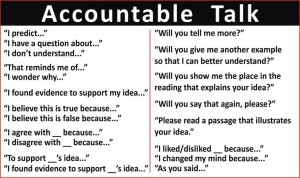
accountable talk

Shared as a part of Lyn Sharratt’s presentations to Metro schools

Accountable talk takes time and effort to implement. The teacher has to create norms and skills in the classroom by modelling discussion, questioning and probing and leading conversations. Then academically productive talk has to be co-constructed by the teacher and students. It is working towards a thinking curriculum.  Setting up predictable, recurring routines that are well-practiced will assist students from different ethnic or cultural backgrounds as everybody will learn and share what is expected in the process of using accountable talk.

Conversations can be at a number of levels – whole class, small group, partner and peer or teacher conferences. All students have the right to engage in accountable talk and these discussions should occur across all year levels and in all learning areas.
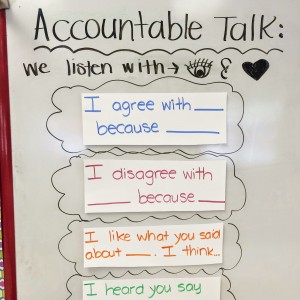
accountable talk for littlies

from Susan Jones (thank God it’s First Grade blog)

Anchor chart

Accountability to the learning community

Students need to listen to one another and pay attention so they can use and build on another person’s ideas. The idea is to be able to paraphrase and expand on ideas, clarify when meaning is lost and to disagree respectfully. Both students and teachers will need patience, restraint and focused effort. In a classroom, there will be students actively talking together, participation in a variety of talk activities, attentive listening, respect, trust and risk-taking, challenges, and criticism and disagreement will be aimed at the idea, not the person.

Accountability to accurate knowledge

When students make a claim or observation, it needs to be as specific and as accurate as possible.  In a classroom, students would make specific reference to previous findings to support arguments and assertions and unsupported claims would be questioned for further information, facts or knowledge.  Students would be concerned with ensuring what they are saying is true and supportable.

Accountability to rigorous thinking

Claims and evidence would be linked together in a logical, coherent and rigorous manner. Evidence is examined critically. Different disciplines vary in the types of evidence. To support how a poem conveys emotions, the speaker may cite multiple pieces of textual evidence to support the interpretation.  In history, the speaker may use historical facts to support a position that began as an opinion. In maths, the speaker will use a mathematically relevant basis to support their intuition. Attention will be paid to the quality of the claims – how well support? Is the evidence good? Is it sufficient? Authorative?  Relevant? Unbiased?

How to set up accountable talk in the classroom

  1. Begin with a focus on academic purposes –  this is critical. As a teacher,  what are the academic goals for the lesson? What are the key concepts students need to learn?  What are the big ideas they need to grapple with? How do the ideas linked to work already done?
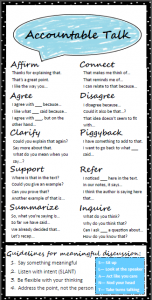
    accountable talk poster

    Anchor chart from https://tackk.com/fzmr3b

  2. Ask what kind of instructional talk will support the accomplishment of those purposes – it needs to provided points of entry and opportunities for engagement for all student
  3. Plan – there needs to be a clear introduction of the task, time for student activity and a clear recap of the point, the big ideas that have been discussed and the new understandings that have been arrived at
  4.  Consider the best class format to facilitate these academic goals – whole group, small group or partner work? Should the topic be set up and then stopped at a certain point for a partner discussion?

NB Recurring, familiar events and activities that take place at a certain time, in consistent ways and for consistent purposes will ensure that all students know how to participate in the conversation.

My thoughts

There is a lot of information around accountable talk on the internet. The link below has a video that captures the essence of students using accountable talk. It also has the anchor chart and featured image that I have used for this blog page.

Accountable talk will require lots of modelling and a slow, co-construction of sentence starters and guidelines. It links beautifully with many pedagogies and frameworks already being used in schools, such as Philosophy or yarning circles.

I also love how accountable talk can be used for any year level and in any learning area. Imagine the power of conversation that students can participate in if accountable talk has been fostered from the early years of schooling.

I love the phrase – a thinking curriculum. Accountable talk uses a gradual release model and builds to students doing the thinking and the talking…..about the curriculum with which they are learning.
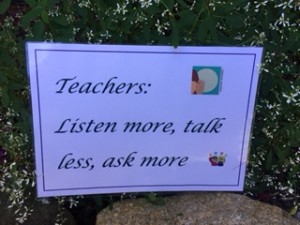
Poster from Cheryl

Thanks to Cheryl for sharing this with me.
 

Grand Conversations

Grand Conversation in Primary Classrooms

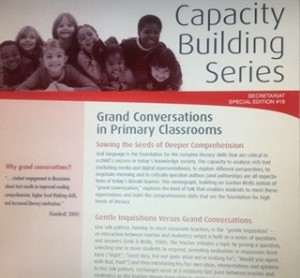
So much for my 30 posts in 30 days. Unfortunately, work commitments beat me this week and I am now about five posts behind my goal. My oral language workshop still prevails so tonight’s blog will look at Grand Conversations in Primary Classrooms, an article published as a part of the Capacity Building Series. This series was produced by the Literacy and Numeracy Secretariat to support leadership and instructional effectiveness in Ontario schools and the article I am referring to is 18th in the list.grand conversation

I was introduced to the article when Lyn Sharratt (co-author of Putting Face on the Data) visited Metropolitan schools in February this year. Lyn chose an activity whereby each table group member was assigned a section to skim and scan in the article and then jigsawed to share the information gleaned.

Oral language is the foundation for the complex literacy skills that are critical to a child’s success in today’s knowledge society (Grand Conversations in Primary Classrooms, p.1) . The article begins by exploring the difference between gentle inquisitions (one talk pattern where the teacher is in charge and builds on a series of questions and answers) compared to Grand conversations (authentic, lively talk about text that has the potential to foster higher-level comprehension and student’s attitudes to reading). The talk pattern of a grand conversation is conversational where students and teachers exchange ideas, information and perspectives. The teacher is a member of the group, stepping in only when needed to facilitate and scaffold conversation.

This methodology works beautifully when you consider: who is doing the thinking? who is doing the talking?

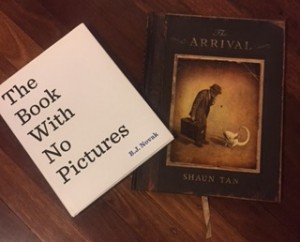
The critical first step is the choice of text – it needs to be stimulating and to support a grand conversation. It needs to be sufficiently challenging and multi-layered. For non-fiction, choose a text that presents content clearly and at times provides strong visual support. For a fiction text, choose books with interesting plots and characters, detailed descriptions and dialogue. Poetry and wordless picture books are also great choices. The arrivalThe limited text of wordless picture books requires students to infer, make predictions and to express personal thoughts, feelings and opinions.  The images must be visible to all participants.
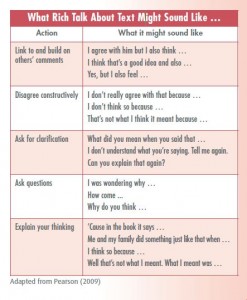
Modelling conversational skills

Students need to taught how to consider the ideas presented in the text, how to share and defend their ideas and opinions and how to build on and question ideas of others. Initially, teachers may initiate conversations, ask big questions and model appropriate discussion skills. They will also need to be ready to step in and offer new questions or prompts when redirection is necessary. A teacher’s role will include assisting students to: accept different ideas and opinions;  practise turn-taking and discussion techniques; and encourage the quieter students to have-a-go.

Teachers can model and students can practise these skills both in a whole class and small group situation. Anchor charts can be developed with students to record rules and norms for productive conversations.

Grand conversationThe teachers’ role in a grand conversation shifts form discussion director to discussion facilitator to participant as students gain greater independence and proficiency (again this fits with the gradual release of responsibility).

Examples of Authentic Questions

• What do you think the author wants us to think?

• How would the story be different if another character was telling it?

• How does the author show his point of view? Do you agree?

• What do you think was the most important thing that happened?

• What was something that confused you or that you wondered about?

• How did you feel about what happened in the story? What made you feel that way?

• Are you like any of the characters?

In what ways?

• Did you agree with what (character’s name) did? Why?

• What do you think will happen next?

What do you think (character’s name) will do? What would you do in the same situation?

• Is there someone in the book you’d like to talk to? What would you say? What makes you want to say that?

Preparing Students for Discussion

The paper lists and describes a number of engaging and innovative strategies to support student thinking about the text prior to classroom discussion. These include:

  • Literature logs and journals  – students can record personal ideas, reactions, questions, connections and learning from their reading – provides sudents with the opportunity to reflect on and ‘ink their thinking’ (Donnelly, 2007) prior to discussion.
  • Consensus board – after reading a rich text, each student draws a picture of what they think should be the focus of the discussion. Young students can label and older students can write a sentence or two. The pictures are grouped and labelled so that students can see what is considered most important and worthy of discussion (McGee and Para, 2009).
  • Sketch-to-stretch – students use sketches to respond to a text being read to, with or by them (either at key points or at the end). Rather than a drawing, they use images, words, shapes and other symbols and then share their sketches in small groups as conversation starters (Whitin, 1996).
  • Close reading of a text passage – students are invited to assist in selecting an important part of the story and then read, reread and discuss the passage in a small group to work out author’s stated and implied messages.
  • Traffic lights – a good strategy for independent readers. Students are provided with three colours of post-it notes: green for parts of the text they agree with, think are important or make a connection with; red for parts they disagree with, did not like, make them upset etc; and yellow for parts they found confusing, left them wondering or raised questions.

Structuring Grand Conversations

Grand conversations have many names: literature circles, books clubs, reading response groups and literature discussion groups. Students come together to talk about text they have read or had read to them in order to answer to questions the text as they look at it from different points of view.

My apologies to the authors: the following lists are basically word for word of what is in their article:

Teacher read alouds

  •  Provides a context for rich conversations at all grade levels, especially when students are unable to read challenging and conceptually complex texts.Reading aloud
  •  Most commonly used as a whole-class activity.
  •  Frequently use picture books, both fiction and non-fiction,
  •  Bring students physically close to the text and hold it so that students can observe the pictures
  •  Students are encouraged to listen to the words and simultaneously examine the pictures in order to make sense of the text.
  •  Often the teacher interjects questions to assist students in clarifying understandings and constructing an overall understanding of the message conveyed by the text.
  •  After reading, teachers can use the read-aloud text to kick off a grand conversation.
  •  Students form a circle so that all speakers can see and hear one another.
  •  Teacher and students review collaboratively-established norms for group discussions.
  •  Teacher introduces a big question or prompt to initiate discussion and scaffolds the conversation as necessary.

Shared and guided reading groups

  • Opportunity for students to practise student-led conversation about a text.
  • After using a shared or guided approach to read a common text, the teacher presents a big question or prompt related to the text.
  • Following review of the class anchor chart for grand conversations, the teacher withdraws, providing an opportunity for reading group members to engage in student-led conversation stemming from the question or prompt.
  • Teacher checks in with other students and observes the functioning of the discussion group from a distance.
  • After a few minutes, the teacher returns to the group and joins the conversation in progress.
  • Students are encouraged to share, explain and elaborate their thinking about the question or prompt.
  • Teacher may assist in resolving conflicts that may have arisen as a result of conflicting opinions or procedural issues such as turn-taking and conversation domination.
  • Before ending the session, teacher and students reflect on and assess the functioning of the group in relation to the class guidelines for grand conversations.

Literature circles

  • Small groups of students (about three) can come together around a common theme or big idea using one or more texts.

  • Teacher selects books for these small-group discussions based on student needs and interests.

  • After listening to “book talks” given by the teacher, students may choose the text for their group discussion by holding a vote.

  • Before beginning the discussion teacher may want to introduce students to various conversational roles – such as discussion director, illustrator, word wizard and connector – as a way of scaffolding student-led conversations.

    NB Goal is for students to participate in grand conversation without taking on a specific role.

Instructional conversations

  • Whole-class or small-group discussions about a common text that combine instruction and conversation.
  •  Intended primarily to help students extract information from a text.
  • Teacher begins with a specific curriculum goal in mind – a theme, topic or concept – and facilitates classroom conversation in order to meet that goal.
  • Teacher and students share their prior knowledge and integrate it with new information gathered from the text to extend understanding of the topic or concept.
  •  Teacher facilitates sustained discussion encouraging students to share and clarify understandings, link new knowledge to prior knowledge and consider issues presented in the text from various points of view
  • Teacher brings closure to the conversation by summarizing, drawing conclusions or establishing goals for the next conversation.

Idea circles

  • Heterogeneous small groups that support discussion focused on learning about a concept.

  •  Purpose is to have students build an understanding of a concept through the dialogic exchange of facts and information (Guthrie & McCann, 1996).

  • Goal is to ensure that each student leaves the group with a clearer, more thorough and more accurate understanding of the target concept.

  • Multiple concept-related texts, at varying levels of reading difficulty, are provided by the teacher.

  • Each student reads their selected text, either independently or with a partner, for the purpose of gathering information about the topic under discussion.

  • Students then bring their information to the circle where the information is shared, clarified, extended and debated in order to co-construct a deeper and more elaborate understanding of the concept.

In conclusion

Being able to think deeply, articulate reasoning and listen purposefully increases student engagement. Grand conversations allow students to be leaders in a collaborative process that promotes the discussion of text in a meaningful way. This supports higher-order thinking skills and increases student learning and achievement.  Who is doing the thinking and who is doing the talking in your classroom?

As we move through the gradual release of responsibility, it should move from teacher to student!


Oral rehearsal

I am about to put together a presentation on oral language so my next few blogs will explore the research that supports this area. There are many aspects to oral language and I have already explored  Konza’s work on oral language as part of the Big 6.

This blog will consider the importance of oral rehearsal, something that Lyn Sharratt (author of Putting faces on the data) paid a lot of attention to in her recent work with Metropolitan schools in Brisbane, Queensland.

It is interesting when you google ‘oral rehearsal’ – there isn’t much about it. Yet, oral rehearsal in writing is a necessary prerequisite for thoughtful writing pieces (Sharratt & Fullan, 2012).

Not only is it necessary for writing, but any speaker should be given opportunity to rehearse before sharing their thoughts in a public forum. This includes teachers in staff meetings and professional development and of course, students before they have to share orally in the classroom.

This makes sense – how many of us ‘rehearse’ what we are going to say prior to a formalised presentation. One of the reasons I sometimes avoid contributing in a public forum, is because I haven’t had the opportunity to rehearse what I would like to say. If I feel like this, how do some of my students feel?scared

Calkins (2001) stated that, ‘In schools, talk is sometimes valued and sometimes avoided….and this is surprising – talk is rarely taught…Yet talk, like reading and writing, is a major motor – I could even say the major motor – of intellectual development’ (p.226).

A search in the United Kingdom of the term, Oral Rehearsal, undertaken by the Department for Children, Schools and Families found ten references:

  • Using writing partners and oral rehearsal, 
  • After oral rehearsal, write explanatory texts independently from a flowchart or other diagrammatic plan, using the conventions modelled in shared writing. 
  • Rehearse sentences orally before writing and cumulatively reread while writing
  • The trainer repeatedly models rehearsal of sentences in speech before committing them to paper…
  • The importance of oral rehearsal and cumulative re-reading
  • Oral rehearsal before writing 
  • Rehearse sentences orally before writing and cumulatively reread while writing 
  • A range of drama and speaking and listening activities that support appropriate oral rehearsal prior to the written outcomes. 
  • Oral rehearsal prior to writing…. In pairs, children rehearse phrases and sentences, using some of the ideas suggested. 
  • Scribe the sentence, modelling its oral rehearsal before you write it. 
  • Oral rehearsal: in particular, those children who have poor literacy skills; for children with poor language skills.

All of these refer to rehearsing orally prior to writing. I would go further and promote oral rehearsal before speaking informally and formally.

A study by Myhill and Jones noted that a teacher employing oral rehearsal practice in her classroom observed improvement in the use of imaginative written text and in low-attaining writers. She attributed improvement in her student’s writing to the fact that oral rehearsal allowed the children ‘to think about before writing it down’ and that oral rehearsal made it ‘easier to change it [writing] in talk than when it had been written down.

oral rehearsalGive students the opportunity to talk things out prior to speaking publicly or to written responses!


 

Teaching reading to the older student

Teaching reading doesn’t have an end date. As students enter into later primary and secondary education, it is important that all teachers in any subject area are assisting them to navigate and understand these increasingly more complex and sophisticate texts. This is even more important for readers who are struggling. Sometimes as teachers of upper primary and secondary students, it is hard to find something that supports the teaching of reading.

Tactical Teaching Reading

At the end of 2014, I was introduced to Tactical Teaching Reading. The sole licensed distributor is Tactical  Steps Education who have taken over STEPS professional development. Their motto for Tactical Teaching Reading says it all – Not a reading teacher but a teacher of reading. Reading is in every learning area and the strategies taught in this course are applicable to any learning area. Tactical Steps Education offers both teacher and facilitator courses.

Workshops

The course involves three workshops:

Workshop 1 – How to help students use reading processes. This workshop looks at research on adolescent literacy and a number of processes that can be used before, during and after reading. Processes that are incorporated include activating background knowledge, clarifying vocabulary, monitoring understanding and processing what has been read.

Workshop 2 – How to make reading strategies visible. Good readers use a number of strategies when reading. These include adjusting reading rate, predicting, connecting and self-questioning. Struggling readers need these strategies to be explicitly taught. This workshop looks at the explicit teaching of reading strategies to help students understand texts. It considers 18 universal strategies used by good readers. Again the strategies are aligned to before, during and after reading.

Workshop 3 – How to build text form knowledge. Text complexity and sophistication increases as students progress in their schooling. All students need to be taught how to navigate these more sophisticate texts in their various contexts. This workshop helps teachers to build students’ ability to pinpoint purpose, organisation, language features and text structures of subject area texts.

Participants in this course are provided with three course books and each contains 14 practical activities that can be used repeatedly in lesson with texts already in use. I found that some of these strategies were ones that I was familiar with or had used once upon a time and forgotten.  What I really like is a quick reference to some before, during and after reading activities that can be applied to any learning area.

At the end of 2014, I spent time relating some of these strategies to reading in secondary mathematics.  Since then, not only have I used these strategies in the classroom, but I have also used them for adult learning.

Pinpointing purposes

Percentages

Pearson Mathematics textbook year 8

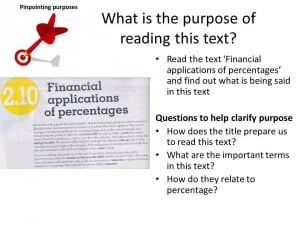
I applied the strategy Pinpointing purposes to this mathematical text. This strategy required students to preview the text and set a purpose.  Students self-questioned to clarify the purpose of reading and to consider how they would achieve that purpose. Pinpointing purpose

This was a great strategy in that it helped students comprehend the text, enabled them to skim and scan and to determine the importance of what they were reading. I was then able to have students apply the reading to a context.

Clarifying questions:

How does the title prepare us to read the text?

What are the important terms in this text?

How do they relate to percentages?

Students worked in pairs and did a think pair share where they shared their purpose for reading. They then decided on a joint purpose. Student then reflected on the steps they undertook to achieve the purpose.

By applying this information to something contextual, it made the reading so much more meaningful. In this case, students related the content of applying percentages to financial transactions to selling soft drink at the market stall.

Benchmarking percentages

Application of the information to a ‘real-life’ context.

More Words of Comprehension Wisdom

Sheena Cameron

I am so impressed with Sheena Cameron’s book, Teaching Reading Comprehension Strategies a practical classroom guide, that I will continue to share some of her wisdom.

Introducing and teaching comprehension strategies

Cameron has adapted a model from Duke and Pearson (2002) for introducing and teaching comprehension strategies in the classroom. She includes five components:

  1. An explicit description of the strategy, which includes when and how it should be used – in the gradual release of responsibility this is part of the I do it stage.
  2. Teacher modelling of  the strategy in action – again this is part of the I do it stage.
  3. Collaborative use of the strategy in action – we do it stage.
  4. Guided practice using the strategy with gradual release of responsibility  –  this could fit both in the we do it and the you do it together stage depending on where the students are at.
  5.  Independent use of the strategy – you do it alone.
homonyms

This is a newspaper text I have kept and laminated as it is perfect for teaching vocabulary and figurative language.

Modelling

Cameron mentions how important is to be modelling strategies to students of all ages. She stresses the importance of preparation prior to modelling and that sticky notes can be helpful prompts. Once the preparation is done the first time, it is easy to use multiple times. Her advice is to begin collecting texts that are suitable to model particular strategies.

Think-alouds

She also mentions the use of think-alouds (Davey,1983) as being a simple but extremely effective technique. This helps those who struggle with reading. They can hear and see what a good reader does when making meaning from text. It is also important that students practise think-alouds – as teachers we can quickly find out what students are thinking and how they are using the various strategies.think alouds

Handy hints

To conclude this post, here are some of the handy hints that Cameron suggests  to assist implementation of the comprehension strategies:

  1. Use a wide variety of materials to model: stories, textbooks, articles and visual texts such as photographs, graphs, maps and tables. I really agree with this – there are so many good, short and interesting texts out there. Find texts that fit within the learning areas of the curriculum – they provide context and teaching comprehension strategies doesn’t become an add-on.
  2. Plan think-alouds.
  3. Read the text aloud, pausing to make comments about what you are thinking (don’t this so much that the flow of the text is interrupted).
  4. Focus on the strategy you are teaching. If appropriate, refer to already taught strategies where applicable.
  5. Keep the modelling session short and sharp – hook in the students.
  6. Take a few opportunities to show word attack and fix-up strategies.
  7. Remind students that all readers get stuck sometimes, but good readers stop, clarify the problem and do something about it.

Cameron, S. (2009) Teaching Reading Comprehension Strategies a practical classroom guide

Comprehension – a practical approach

Since beginning my blogs, I have had several colleagues recommend the work of Sheena Cameron. As I have focused on comprehension in the last few blogs, it was timely to look at Cameron’s text Teaching Reading Comprehension Strategies a practical classroom guide. Luckily, one of my work colleagues had a copy of Cameron’s book and I have spent the afternoon skimming and scanning her text. Her book is easy to read and very practical with lots of resources.

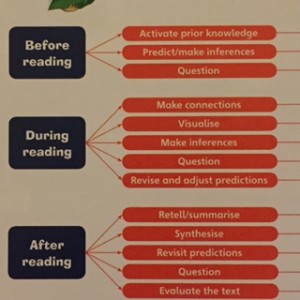
Cameron is an experienced classroom teacher and her book reflects this experience and current research. Her introduction acknowledges the importance of comprehension and the strategies that active readers use when engaging with text. Like many articles and texts on the teaching of reading, these active strategies used by good readers are divided into three stages of reading – before, during and after.

Cameron identifies a number of reading comprehension strategies and has organised them into groups: nine key strategies that often appear in research; two strategies that are important but receive less recognition; and two additional strategy sets that are indispensable to readers at any level.

Group 1 – Key strategies

  1. activating prior knowledge

    IMG_1181

    From Cameron, S. Teaching Reading Comprehension Strategies (2009) p 11

  2. self-monitoring
  3. predicting
  4. questioning
  5. making connections
  6. visualising
  7. inferring
  8. summarising
  9. synthesising

Group 2 – Other useful strategies

  1. skimming
  2. scanning

Group 3 – Additional strategy sets

  1. word attack strategies
  2. fix-up strategies

(Cameron, 2009, p9)

I really like how these strategies align quite nicely with those recommended in the elaborations of year 4 Australian Curriculum English (ACELY1692).

Cameron states that reading comprehension can be developed by: teaching the strategies explicitly; using a cooperative learning model; using the strategies flexibly and combining them; using the strategies across all learning areas; and building vocabulary knowledge.

She summarises her introduction by stating that a reader is not truly reading without comprehension; that the strategies are a method of helping students understand what they are reading; and that good comprehension enables purposeful and active reading.

I am very impressed with this text and intend to purchase a personal copy – a recommended read!


Question Answer Relationships

Question Answer Relationships

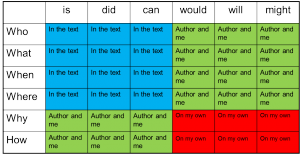
Another questioning framework that assists comprehension is Question Answer Relationships (QAR). It also provides a lovely segue from using Blank’s level of questions in the early years (subject of previous blog).

QAR was developed by Taffy Raphael whom I had the pleasure of listening to a few years ago. QAR demystifies the questioning process, provides a common language within and across year levels and across learning areas and logically organises comprehension strategies  It inspires students to think about the text they are reading and beyond it. They can work cooperatively and are challenged to use literal and higher-order thinking skills.

It is important to model the use of QAR. Once again, I would recommend using the gradual release of responsibility – I do it, we do it, you do it together and you do it alone. It is also an opportunity to promote discussion and debate around responses to questions and how they worked them out.

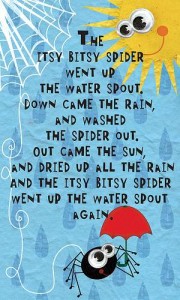
There are four levels of questioning:Itsy bitsy spider

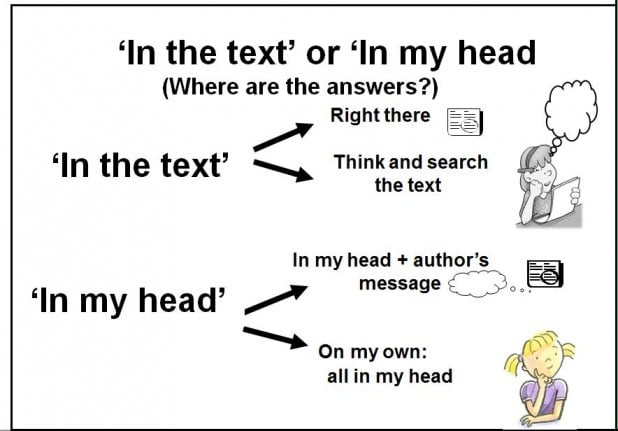
  1. Right there (literal) – readers focus on and retrieve explicitly stated information. Often the answer will be a single sentence or place in the text, and the words used to create the question are often also in the same place.  Who climbed up the water spout?
  2. Think and search (simple inference) – readers make inferences. The answer is in the text, but the reader may have to look in several different sentences to find it. It is broken up or scattered or requires a grasp of multiple ideas across paragraphs or pages. How many times did the spider climb the spout?
  3. Author and me (higher order inference) – readers interpret and integrate ideas and information. The answer is not in the text, but the reader still needs that information combined with what they know to respond to this type of question. Why do you think the spider decided to climb back up the spout?
  4. On my own (analysis/evaluation) – readers examine and evaluate and respond to the content, language and textual elements. The answer is not in the text. Have you ever tried and failed at something the first time, and yet had the courage to come back and try again?

Using QAR to Develop Self Questioning

from Kay Rankin The teaching of reading 2009

QAR is perfect for developing self questioning.

Red Dog FTI cvr.inddTeacher think aloud: “As I read the text, I picture what is happening here. I think about the text more deeply, generate (make up) questions, and formulate (work out) answers to my questions.”
At the junction with the main road, Red Dog tugged at the sleeve of the driver, and kicked up a fuss until he stopped. He alighted there and went to wait for a car that he recognised.

Shortly he detected the noise from Patsy’s engine. It had loose tappets and a small hole in the exhaust. As soon as it appeared, he ran out in front of it, and Patsy skidded to a halt.

‘You nearly gave me a heart attack,’ she said as she reached over to the passenger door to let him in. Red Dog leaped in and make strange motions with his head, which Patsy

interpreted as a request to open the window on his side. They drove off together, he with his head out of the window to catch the breeze, and she recovering her equanimity after such a sudden halt. ‘One day,’ she said to Red Dog, ‘You’re going to get munched by a car.’

from Red Dog written by Loui de Bernieres

  • What did Red Dog do to make the bus driver stop? Right there
  • How did Red Dog recognise Patsy’s car? Think and search
  • How could Patsy accuse Red Dog of causing her to have a heart attack? Author and me
  • Should drivers be stopping for Red Dog when he runs out in front of cars or is this just encouraging his dangerous behaviour? On my own
Q Chart

Kay developed a Q Chart that models some of the questions that good readers ask

Before, During and After Reading

QAR can be used at three stages of reading.

Before reading:

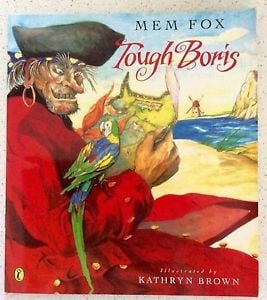
On my own: From the title and front cover, what do you already know that can connect you to the story/text? Tough Boris

Author and me: From the book cover, what do you think the story might be about?

During reading:

Author and me: What do you think will happen next?

Think and search: What is the problem and how is it resolved?

Right there: Who is the main character?

After reading:

Author and me: What is the author’s message?

Think and search: Find evidence in the text to support the argument that Boris is a caring pirate.


QAR and Comprehension Strategies

QAR can also be linked to specific comprehension strategies. Taffy Raphael makes a number of connections in her powerpoint Question Answer Relationships (QAR): A Framework for Improving Literacy Teaching and Learning.

I believe that QAR is powerful because it creates a common language to discuss text. It also unlocks some of the mystery around answering comprehension questions and navigating text. I have used it from years 2 to year 7 and for any text (including song lyrics and non-fiction text). When introducing it to younger students, I have begun with the two simple categories of In the book and In my head. QAR is brilliant for building self questioning and encouraging discussion and respectful debate around responses.

Featured Image from Rankin, K.  The teaching of reading 2009

Blank’s Levels of Questioning

Blank’s Levels of Questioning

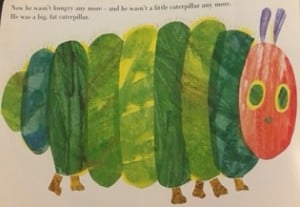
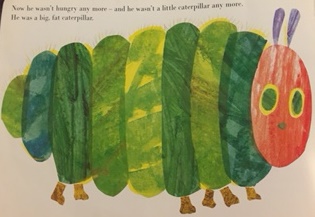
hungry caterpillarIn my last blog, I looked at Konza’s sixth component of teaching reading: comprehension.  Konza mentioned the importance of questioning as a comprehension strategy. One of the questioning frameworks that I have used quite successfully is Blank’s levels of questions.
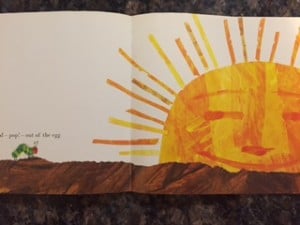
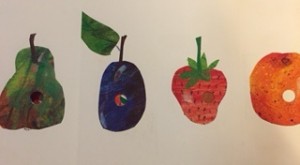

It was devised by Marion Blank, an American developmental psychologist who specialised in language and learning. She studied a number of year one students to find levels of comprehension that equated to success in the classroom.

Blank found four different levels of questions. Levels 1 and 2 ask for simple concrete information and levels 3 and 4 ask for more abstract information. Both receptive and expressive language skills are required.

Level 1 – language is applied to what is seen in the everyday world. Information is directly in front of the reader or recently removed. Responses are short or nonverbal (eg pointing).

Hungry caterpillar 2

Level 1 – Show me the sun.

Scanning for a matching object – Find one like this.

Identifying an object by sound – Show me what you heard.

Identifying an object by touch – Show me what you touched.

Naming an object heard – What did you hear?

Naming an object touched – What did you touch?

Naming an object seen – What is this?

Imitating a simple sentence – Say this…..

Remembering pictured objects – What did you see?

Remembering incidental information – What did you see?

Level 2 – information is supplied but it is not directly apparent. Reader has to select what to attend to – size, colour etc

Hungry caterpillar 4

Find fruit that is red and spotty.

Scanning for an object defined by its function – Find one that can…

Describing a scene – What is happening?

Recalling items named in a statement – What things…?

Recalling information from a statement – Who? What? Where?

Completing a sentence – Finish this….

Concepts: Naming characteristics and functions of objects – Tell me its …..

Concepts: Attending to two characteristics – Find one that is … and ….

Concepts: Identifying differences – How are these different?

Concepts: Citing an example within a category – Name something that is a ….

Level 3 – language does not directly relate to what is seen or heard and reader must think about and reorder the given information. Consideration and evaluation of certain basic facts are considered before a response.

Hungry caterpillar 3

How did the caterpillar feel when he had finished?

Scanning for an object by integrating verbal and visual information – Find one to use with this.

Describing events subsequent to a scene – What will happen next?

Assuming the role of another person – What could he say?

Following a set of directions – Do this, then this.

Arranging pictures in a sequence – Make these into …

Formulating a set of directions – Tell me how to…

Formulating a generalisation about a set of events – What happened to all of these?

Formulating a statement to unify a sequence of pictures – Tell this story.

Concepts: Identifying similarities – Find the ones that are not…

Concepts: Selecting an object by exclusion – Find things that are not …

Concepts: Selecting a set of objects by exclusion – Name something that can… but is not a ….

Concepts: Citing an example by excluding a specific object – Name something that is not a ….

Concepts: Citing an example by excluding a class of objects – What is a ….?

Concepts: Defining words – Say this……

Unusual imitations

Level 4 – reader has to reason beyond what is seen, heard or said. Reader has to draw on past experience, make parallels, look at causes and likely effects and justify decisions.

Hungry caterpillar 5

Why can’t he eat anything else?

Predicting: Changes in position – Where will ….?

Predicting: Changes in structure – What will happen if …?

Justifying a prediction – Why will…?

Justifying a decision: Essential characteristics – Why wouldn’t it?

Justifying a decision: Non-essential characteristics – Why would it?

Identifying the causes of an event – What made it happen?

Formulating a solution – What could you do?

Formulating a solution from another perspective – What could she do?

Selecting the means to a goal – What could we use?

Explaining the means to a goal – Why should we use that?

Explaining the construction of objects – Why is …. made of that?

Explaining an inference drawn from an observation – How can we tell?

Explaining the logic of compound words – Why is this called …?

Explaining the obstacles to an action – Why can’t we …?

Reference: Blank, M., Rose, S., & Berlin, L. (1978). The language of learning: The preschool years.

These levels of questions help develop comprehension but also develop oral language using rich text. Although the example of The Very Hungry Caterpillar is for younger students, the levels of questions can be applied to any text and any year level.

NB If you are a teacher in the Queensland State School system, the Metropolitan EAL/D Prep Program edStudio can be accessed through the Learning Place (S712114786). This edStudio houses a number of rich texts that can be used with Blank’s levels of questions.


The Pinnacle – Comprehension

Understanding the Reading Process – The Big Six

The final component of Konza’s Big Six and the goal of reading is comprehension. Each of the first five components of the Big Six contributes to comprehension. This is a summary of Konza’s original paper and the supporting paper on comprehension.

Comprehension

10motivaposters-seussComprehension is not just finding answers in a piece of text – it is an active process whereby the reader creates a version of the text in his or her mind (Konza, 2011).
To comprehend text, students not only need to be able to decode but to also understand: vocabulary; background knowledge; the semantic and syntactic structures to help predict relationships between words; and verbal reasoning. Comprehension requires engagement with the text at a deep level.

Researchers have identified a number of behaviours and strategies that good readers use to gain meaning from text.  The following are four important behaviours that characterise good readers and these are expanded upon in Konza’s supporting paper on comprehension.

Briefly, good readers:

  1. Understand the purpose of their reading– they know why they are reading and how to accomplish the task eg when to skim, when to scan or when to read closely.
  2. Understand the purpose of the text – they are aware of how the author’s purpose is reflected in the a text and the particular characteristics of different text types.
  3. Monitor their comprehension – they can integrate what they are reading with what they already know; focus on relevant parts of the text; distinguish between major content and supporting detail; monitor predictions; and evaluate content.
  4. Adjust their reading strategies – they know when to go back and reread; when to slow reading rate; and when to use chunking and decoding strategies with their vocabulary knowledge.

Levels of text comprehension

Independent level: reader can read most of text fluently (no more than 1 in 20 words difficult – success rate of at least 95%).  To gain meaning from the text, students need to be able to read it fluently.

Instructional level: reader finds text challenging but manageable – can read with support (1 word in10 is difficult or unknown – success rate of 90%). Must have support.

Frustration level: reader has difficulty with more than 1 word in 10 – success rate less than 90%.  Constant interruption results in frustration. Reading the text aloud exposes them to more sophisticated language structures and vocabulary – teacher can also do think alouds.

Guidelines and strategies

  1. Comprehension needs to be taught, not just tested – strategies need to be taught and explained along with guided practice.
  2. A variety of reading materials should be used, including short text – text types of all lengths can be used with short ones being particularly useful for struggling readers.
  3. Active listening should be taught – oral comprehension precedes reading comprehension but requires active listening. Give students tasks such as listening for specific information and teaching them strategies to remember the information. Barrier games require active listening and can be adapted for any age group.
  4. Readers need multiple strategies – students need a range of active comprehension strategies (see below – elaborations from Year 4 Australian Curriculum English).

Specific strategies for developing comprehension

I will list Konza’s specific strategies and a couple of the ideas. For more detail, go to her supporting paper.

  1. Prepare students before reading – what do students already know, make predictions using title and illustrations, discuss other texts on similar topic, introduce new vocabulary.
  2. Facilitate engagement during reading aloud – read story/section with few interruptions – questions before and after reading more effective than during reading, emphasise new words that were introduced before reading, stop a few times for comments.
  3. Facilitate student comprehension during independent reading – teach students to use ‘fix-up’ strategies when meaning is lost, help them make connections.
  4. Promote comprehension after reading – identify key words, look for sequence and cause and effect, link to own experiences, retell story in different way – puppets, change the ending, change to another form, use graphic organisers, use glossaries, dictionary and thesaurus.
  5. Use questioning as a comprehension strategy – examples are Blank’s levels of questioning, Bloom’s taxonomy, 3H (Here, Hidden, In my Head).

Guidelines for classroom questioning

Konza also lists a number of guidelines for classroom questioning such as: phrasing questions clearly, using lower order questions and a brisk pace when checking understanding of basic factual material;  using extended wait time for higher order questioning; asking questions before and after reading for older and higher ability students; and mainly asking questions after reading for younger students and those who are struggling.

Konza (2011) concludes by writing that comprehension enhances both the quality of our learning and the quality of our lives. Some children will acquire comprehension skills easily whereas others will require teachers to have a deep understanding of all the processes involved and how best to teach them. the simplest way

My Addition

Australian Curriculum English

For readers in Australia – these are the comprehension strategies mentioned in English/Year 4/Literacy/Interpreting, analysing, evaluating

Use comprehension strategies to build literal and inferred meaning to expand content knowledge, integrating and linking ideas and analysing and evaluating texts (ACELY1692)

  • making connections between the text and students’ own experience and other texts
  • making connections between information in print and images
  • building and using prior knowledge and vocabulary
  • finding specific literal information
  • asking and answering questions
  • creating mental images
  • finding the main idea of a text
  • inferring meaning from the ways communication occurs in digital environments including the interplay between words, images, and sounds
  • bringing subject and technical vocabulary and concept knowledge to new reading tasks, selecting and using
  • texts for their pertinence to the task and the accuracy of their information

Australian Curriculum

Fluency

Understanding the Reading Process – The Big Six

The next component that Konza identified as necessary for the teaching of reading is fluency. This blog will summarise her original paper and the supporting paper on fluency.

Fluency

Fluency Fluency is the ability to read text accurately, quickly and with expression. Background knowledge of the text being read, rapid retrieval of relevant vocabulary and knowledge of syntax and grammatical forms assist students to predict upcoming vocabulary with accuracy and speed.

A student reaches a pivotal point in their reading development when they become fluent. It is the point where ‘learning to read’ changes to ‘reading to learn’. Fluency includes reading rate, appropriate phrasing and intonation. It is interesting my last blog looked at vocabulary and the symbiotic relationship of mutualism. An example of a symbiotic or co-dependent relationship is fluency and comprehension.  If a reader is not fluent, the student will have difficulty comprehending and a reader can only read fluently if comprehension is occurring.

If a student is reading slowly and with many pauses, attention will be focused on decoding and word recognition. To comprehend, a reader needs to be reading 90-100 words a minute which usually develops by the end of year 2 for simple text.

Fluency emerges from extensive practice of independent level text (Konza, 2011). Children who need to practise more often don’t because it is difficult and labour-intensive. They need extended practice reading easily decodable texts – ones that have a controlled vocabulary, allowing students to read a whole book and to develop confidence, fluency and automaticity.

Struggling readers will not develop fluency without practice at their independent level. For older struggling readers, there are now many titles that match their interests but have simple vocabulary and repetition of target words.  Reading aloud to these students and engaging in oral language and word consciousness will help to develop the necessary advanced language structures and vocabulary.

An interesting caveat from Konza’s paper is the research found around the use of Uninterrupted Sustained Silent Reading (USSR). The National Reading Panel found little evidence of this practice supporting the improvement of fluency and comprehension for poorer readers. It is suggested that this time would be better spent assisting these  students to develop the component reading skills.

As I mentioned in a previous blog, I personally do see value in USSSR as it allows time for independent reading. As the teacher however, I take the opportunity to sit beside individual students. I am able to listen to individual reading, collect a quick running record and to ask questions about their reading and the text.

Konza’s supporting paper on the reading component of fluency has a number of interesting sections. It includes elaborations on the three core components of fluency: accuracy;  rapid rate of reading; and prosody (reading with expression).  It has a table reflecting the average rates of reading in the primary years and a description of how to calculate fluency, along with a fluency scale.

Strategies

Konza mentions a number of strategies that assist in the development of fluency. Fluency EmmaThese include:

  1. Modelling fluency in read alouds.
  2. Letter fluency exercises.
  3. Sight word building through word wall activities.
  4. Explicit teaching of punctuation.
  5. Choral reading.
  6. Repeated readings.
  7. Echo reading.
  8. Paired reading.
  9. Poetry reading.
  10. Song rereading.
  11. Readers’ Theatre.
  12. Dialogues an monologues from plays.
  13. Partner reading.
  14. Partner reading with graphing.
  15. Read along books with CD.
  16. Wide independent reading.

Achievement of fluency is the mastery of the components skills whereby a reader can focus on gaining meaning – a cause for celebration.

Woman reading at the beach