
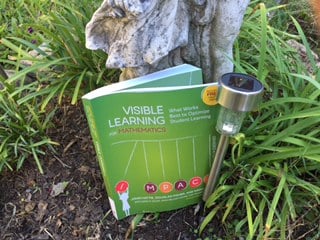
Too often, learning ends at the surface level. (Hattie, Fisher and Frey, 2017, p131) How do we go beyond surface learning and into deeper learning?
As mentioned in my previous blog, surface learning is the beginning of conceptual understanding. The challenge for teachers is not to over rely on it and to know when and how to move students from surface to deep learning. 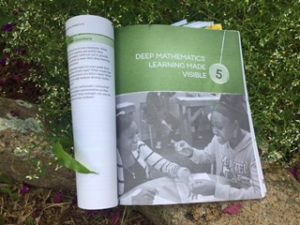 Deep learning (the focus of Hattie, Fisher and Frey’s fifth chapter in their text Visible learning form mathematics) provides students with opportunities to consolidate mathematical understandings and to make deeper connections among ideas.
One of the reasons I write this blog is to take my own reading to a deeper level and to make connections with other research and focuses in my work.
With appropriate instruction, surface learning transforms into deep learning. (Hattie, Fisher and Frey, 2017, p35)
In deep learning, mathematical tasks will be cognitively more demanding, more open-ended and have multiple ways of solving them or multiple solutions. As teachers, we have to make judgments about how much surface learning is required in preparation for this deep learning.
Who is doing the talking?
To promote deep learning, students need opportunities for mathematical talk. 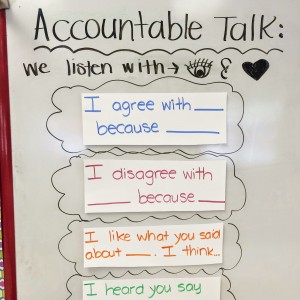 Accountable talk is promoted by Lyn Sharratt in her work in the Metropolitan region. Hattie, Fisher and Frey state that students should be drenched in accountable talk and this chapter provides a number of language frames that scaffold the use of language to support a mathematic topic. A number of other supports for accountable talk are also mentioned.
Who is doing the thinking?
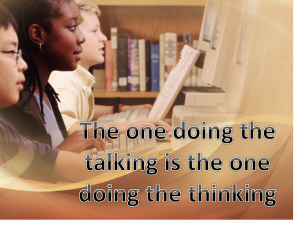 When it comes to mathematical thinking in whole class or group discussion, the authors mention three sociomathematical norms, norms that promote true mathematical discourse. Reading the text gives an insight into how a skilled mathematics teacher can promote the following:
- Explanations that are mathematical arguments and include justifications.
- Errors as opportunities to reconsider problems from a different point of view.
- Intellectual autonomy that recognises participation.
Are students being encouraged to collaborate?
Collaboration is another important dimension of deep learning. Humans learn better when they interact with other humans and the authors recommend that 50% of class time over a week be devoted to student discourse and interaction with their peers. Effective collaboration and cooperative learning tasks must:
- be complex enough that students need to work together.
- allow for argumentation.
- include sufficient language support.
- provide individual and group accountability.
How are students being grouped?
Students should be grouped strategically. The authors point out that fixed ability grouping does not help students to understand the math they are learning. It can affect motivation and make students dislike maths. The most effective grouping strategy is one that is flexible and balanced and allows for a moderate range of skills.
Are you using manipulatives and encouraging multiple representations?
Just as in the surface learning chapter, this one wraps up with a look at the importance of multiple representations and the strategic use of manipulatives to promote deep learning. Students demonstrate stronger problem-solving abilities and deeper mathematical understanding when are encouraged to represent mathematics in a variety of ways. Representations can be physical, visual, symbolic, verbal and contextual.
In the Metropolitan region of Queensland, my colleagues and I have always promoted the think board (an idea we found in First Steps in Mathematics), It can be used in a variety of ways as a graphic organiser for different representations and a way of showing the connections.
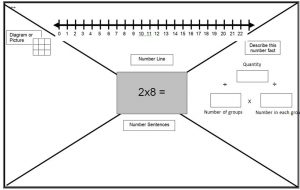
The thinkboard can be used as pre-assessment, formative assessment or collaborative learning

An example of an annotated think board
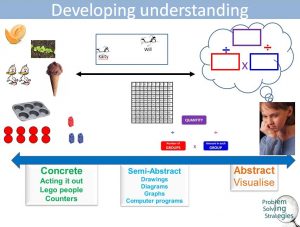
Using the CSA model to develop use of the Multiplication and Division Triangle (a strategy for problem solving)
Manipulatives shouldn’t be limited to surface learning and can be used to make concepts concrete and visible. They assist students to see patterns, make connections and form generalisations. Again the Concrete Semi abstract Abstract (CSA) model (also promoted by my Metropolitan colleagues) is a useful frame to assist teachers with choices around the instructional sequence from physical to visual to symbolic representations.
All of the above have high effect sizes and assist in making deep learning visible. My next blog will look at transfer learning, the application of surface and deep learning.
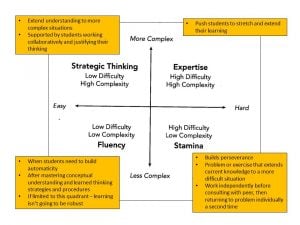
 When students are at the the surface phase of learning, high-impact approaches that foster initial conceptual understanding are followed by linked procedural skills. The tasks are efficient, often more engaging and designed to raise student motivation. When considering the fluency quadrant, many tasks will be of low difficulty and low to moderate complexity. There should be discussion and opportunities to connect the tasks to students’ learning and understanding.
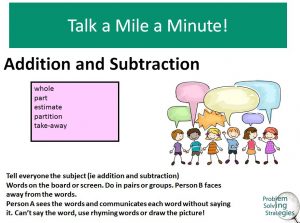 There are many vocabulary games that can be used in warm-up or transition times and we have always promoted the use of word walls and graphic organisers, the latter two being addressed in this chapter.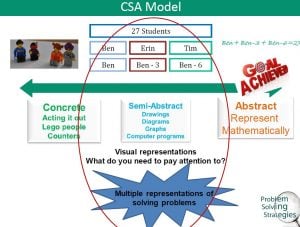
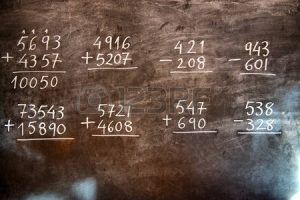 I don’t remember receiving too many problems to solve and I certainly wasn’t allowed to discuss my solutions or ways of working. In fact, there really was only one way to do it – the traditional algorithm as modelled by the teacher – on my own and in silence.

 It begins with careful consideration when planning a unit or lesson and the composing of learning intentions that make the unit or lesson very clear to both the teacher and students. This is extended to consistent evaluation of where students are in the learning process and describing success criteria so that students can assess their own progress and teachers can monitor how students are progressing with a mathematical idea or concept.
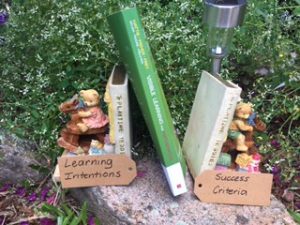 Strategic use of learning intentions and success criteria promote student self-reflection and metacognition which has an effect size of 0.69. One of the most important things a student can learn is internal motivation and Hattie, Fisher and Frey state that learning intentions and success criteria increase student motivation.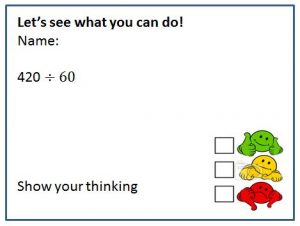

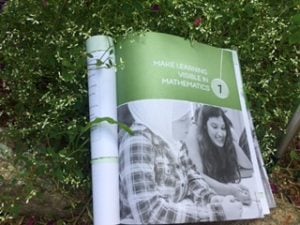 After reading the first chapter of Visible Learning for Mathematics, I spent some time considering how my passion for learning came about. I came to the conclusion that I was lucky enough to enter a profession that I love: one that involves constant re-invigoration and one with which I have a natural affinity. I was also lucky to have two brilliant mentors in my education: my English teacher in year 11 and 12 (Mrs Kay Gardiner) and my Children’s Literature lecturer when I completed my Bachelor of Education (Professor Kerry Mallan).
 As mentioned in my previous blog, I have always loved the challenge of mathematics but was never very successful in my P-12 grades. My experiences were very much ‘chalk and talk’ and the learning of procedures and formulas. I then struggled when it came to applying those procedures and formulas in a test.
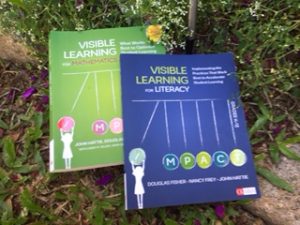 It has been a year since I have visited my site. In that time, I have read and used a number of texts but just haven’t had time to share. My goal this Easter was to re-visit my blog and share a current text. A copy of Visible Learning for Literacy by Hattie, Fisher and Frey was given to all Queensland State School principals at a recent conference. As pre-reading for a professional learning session that I was conducting, I was given a couple of chapters to read and make reference. This pre-reading whetted my appetite and when I found that these authors had also produced a text called Visible Learning for Mathematics, I immediately bought both.
 As I reflect on my own mathematics education, it is interesting that although I never received brilliant grades, I always enjoyed the challenge of mathematics (and still do to this day). I especially love seeing how other people (including students and my own children) solve problems and have learnt so much by engaging in rich and rigorous discussion about these different techniques. As a teacher, this discussion has transferred to effective mathematics pedagogy and how to enhance mathematics engagement for students.